
Does Perfume Expire in the Bathroom? Storage Truth

Does Perfume Expire in the Bathroom? Storage Truth

Table of Contents

Last Updated: October 13, 2026

Does Perfume Expire If Kept in the Bathroom? The Straight Answer

Yes, perfume can expire faster when kept in a bathroom, which is why so many people ask whether perfume expire sooner in this room than anywhere else. Heat, moisture, and light all speed up the breakdown of a fragrance, and a bathroom delivers all three. This guide from MASTAAN Perfumes explains what actually happens to a bottle on the shelf and how to store perfume so it lasts.

The short answer matters because most people never question the shelf. A bottle sits by the mirror for years, and the scent quietly changes. One day it smells sharp, flat, or just wrong.

Below, you'll learn the signs of a spoiled bottle, a simple test for your bathroom, and the storage habits that protect a scent.

Why the Bathroom Is the Worst Room for Fragrance

The bathroom is the worst room in the house for a fragrance bottle. It combines the three conditions that break down scent: heat, humidity, and light. Each one attacks a different part of the formula.

Heat and Temperature Fluctuations

Hot showers raise the room temperature fast. Then the air cools again. That constant up-and-down is the real problem.

Fragrance is a blend of volatile components, the parts that carry the scent into the air. Warmth makes those parts evaporate sooner. Over months, the balance shifts and the scent no longer smells the same.

Humidity, Moisture, and Air Exposure

Steam puts moisture into the air, and moisture gets into the bottle every time it opens. Water and alcohol don't mix cleanly, so the formula can cloud or separate.

Air exposure matters too. Each spray pulls in a little oxygen. Oxygen reacts with the fragrance ingredients, a process called oxidation, and oxidation is what turns a fresh scent stale.

Sunlight and UV Light

A sunny windowsill is the fastest way to ruin a bottle. UV light breaks down the molecules that give a perfume its character.

Even indirect sunlight adds up over time. That's why the original packaging exists. The box blocks light, and it's worth keeping.

How Long Does Perfume Last? Shelf Life by Bottle Status

How long perfume lasts depends on two things: whether the bottle is opened and how it is stored. An unopened bottle in a cool, dark place holds its scent far longer than an opened one sitting in steam. There is no single expiration date stamped on a fragrance, and any timeline you see is an expectation, not a guarantee.

The reason is chemical. A fragrance is a blend of volatile aroma compounds suspended in alcohol. Over time, those compounds react with oxygen, and the lighter top notes, which are the most volatile, are usually the first to fade. What remains is the heavier base, which is why an older bottle often smells flatter or sweeter than it once did. Heat and light accelerate those reactions; a cool, dark, dry spot slows them down.

Bottle Status Storage Conditions Expected Shelf Life
Unopened, in original packaging Cool, dark, dry Several years, often longer
Opened, stored well Cool, dark, dry Two to three years
Opened, stored in bathroom Heat, humidity, light Noticeably shorter
Splash bottle, opened Any condition Shorter than an atomizer, because air enters every time it opens

These are general expectations, not fixed dates. A fragrance built around bright citrus or light florals tends to fade sooner than a deep, resinous blend, because the volatile components that carry those top notes break down first. A splash bottle exposes the liquid to air every time it is opened, while an atomizer limits that exposure to the moment of spraying. The exact timeline varies by formula, by packaging, and by how often the bottle is used.

A common pattern is that a well-stored opened bottle still smells close to the original after two years, while the same bottle left on a bathroom shelf can perfume expire within months. If you are unsure, the blotter test below gives you a direct answer about the bottle in front of you rather than a generic timeline.

Pro Tip If you use fragrance slowly, smaller bottles and the discovery set are a practical way to keep the scent fresh, since you finish them before oxidation has time to work.

How to Tell If Perfume Is Expired: 5 Signs to Check

Knowing how to tell if perfume is expired comes down to five signals. Check them in order, because the first two are the clearest.

  1. A change in smell. The top notes vanish and only a sharp or sour base remains.
  2. A change in color. The liquid darkens, turns cloudy, or separates.
  3. Weak longevity. A scent that used to last all day now fades within an hour.
  4. A harsh opening. The first spray smells like alcohol or chemicals instead of the original blend.
  5. A sticky or gritty residue. Sediment or film on the glass points to breakdown.

One sign alone isn't proof. Two or more together usually mean the bottle has turned.

The Blotter Test: How to Assess a Fragrance That May Have Deteriorated

A blotter test shows what a fragrance actually smells like right now. Spray once onto a paper blotter or a strip of unscented paper. Wait thirty seconds, then smell it. Check again after an hour.

Shop Personalized Perfume Bottles →

If the scent is sharp at first and then disappears, the volatile components are gone. If it smells sour or muddy, oxidation has set in. A healthy fragrance opens clean and settles into its base notes over time.

Pro Tip Never test a questionable bottle on your skin first. A spoiled fragrance can irritate sensitive skin, and the blotter gives you the same answer without the risk.

The Best Place to Store Perfume (and Safe Bathroom Alternatives)

The best place to store perfume is a cool, dark, dry spot away from steam and sun. A bedroom closet, a dresser drawer, or a closed cabinet all work well. Keep the bottle in its original packaging for extra protection.
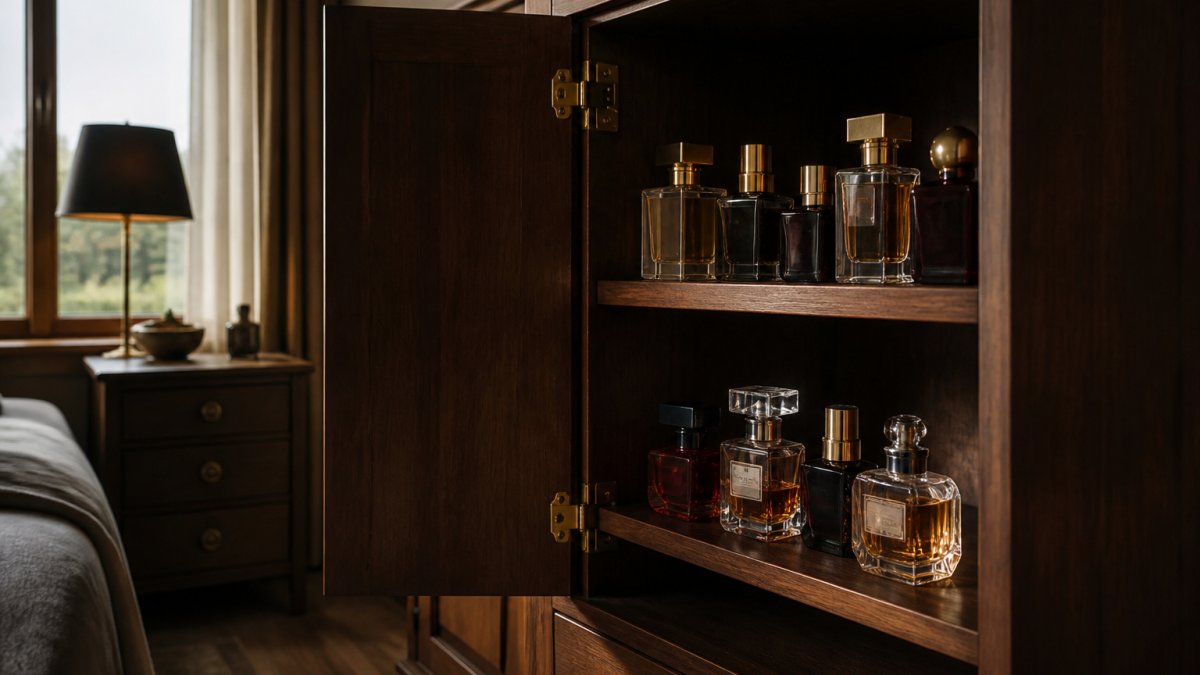
A closed wooden cabinet in a cool, dark bedroom corner with several elegant perfume bottles arranged neatly on a shelf, soft natural light from a nearby window, calm and refined home interior

Safe alternatives to bathroom storage include:

  • A bedroom drawer away from radiators
  • A linen closet on a low shelf
  • A closed cabinet in a hallway
  • A dedicated perfume box or case

If the bathroom is the only option, choose a closed cabinet far from the shower. Add a moisture absorber nearby. It isn't perfect, but it slows the damage.

A Two-Week Test for Whether Your Bathroom Is Suitable

A simple two-week test tells you if your bathroom can hold a bottle. Place a paper blotter sprayed with fragrance inside the cabinet you'd use. Leave it for two weeks.

Check the blotter at the end. If the scent has gone flat, sour, or vanished, the space is too warm or damp. If it still smells close to the original, the spot is workable. This test costs nothing and gives a real answer instead of a guess.

Watch Out Storing a bottle on the windowsill or above the sink is the fastest way to shorten its life. The consequence is a scent that turns within months, not years.

How to Store Perfume Properly: 7 Rules That Protect Your Bottles

Proper storage comes down to seven habits. Follow them and a bottle may help improve how long it keeps its character.

  1. Keep the bottle in a cool place, ideally below room temperature.
  2. Store it in a dark place, away from direct sunlight and UV light.
  3. Choose a dry environment, never a steamy one.
  4. Keep the bottle cap tight to limit air exposure.
  5. Leave the bottle in its original packaging.
  6. Avoid shaking the bottle, which mixes in more oxygen.
  7. Buy smaller sizes if you use fragrance slowly.

What to Do With Perfume Already Stored in a Bathroom

Move the bottle out first. Then assess it with a blotter test before you decide anything else.

If the scent is still close to the original, transfer it to a cool, dark, dry spot and keep using it. If it has turned sharp, sour, or weak, retire it. A spoiled fragrance won't improve with time, and it can smell different on skin than on paper.

For bottles still sealed in the box, the damage is usually minimal. An unopened bottle resists heat and light far better than an opened one.

Key Takeaway The bathroom doesn't ruin a fragrance overnight. It shortens the shelf life quietly, one hot shower at a time. Moving the bottle today is the single most useful step.

Conclusion: Protect the Bottle, Protect the Scent

A fragrance is a crafted blend, and heat, humidity, and light all work against it. The bathroom is the hardest room to defend, but the fix is simple: move the bottle to a cool, dark, dry place and keep it in its packaging.

MASTAAN Perfumes builds scents meant to be kept and worn, not rushed. The collection includes Royal Elixir, Dark Stone, Cherish, La Royale Femme, and a discovery set with four 5 ml fragrances. Selected bottles can be personalized with a name or a special message, which makes them a lasting gift.

Store your fragrance well, and it rewards you every time you spray. Explore the MASTAAN Perfumes collection and add to cart to find a scent worth protecting.

Frequently Asked Questions

Is storing perfume in the bathroom bad?

Yes, it can shorten a fragrance's life. Bathrooms combine heat, humidity, and light, the three conditions that speed up scent degradation. Steam from showers raises moisture levels, which can affect the fragrance inside an opened bottle, while temperature swings from hot showers to cool mornings stress the formula. If you want a fragrance to keep its character, move it to a cool, dark, dry spot like a bedroom closet or cabinet.

Can heat and humidity make perfume expire faster?

They can. Heat accelerates the breakdown of volatile components and fragrance ingredients, and humidity adds moisture that can alter a scent over time. An opened bottle exposed to daily shower steam and warm air may lose its top notes and shift in smell months sooner than one kept in stable, cool conditions. A sealed, unopened bottle is more resistant, but prolonged heat still puts it at risk.

How do I tell if perfume is expired?

Look for a change in smell, a darker or cloudy color, a sour or vinegar-like edge, or a sharp alcohol blast that wasn't there before. Spray a small amount on a blotter or your wrist and compare it to how you remember it. If the opening feels harsh and the dry-down turns flat or unpleasant, the fragrance has likely deteriorated. A bottle stored in a bathroom is more likely to show these signs sooner.

Does perfume last longer in its original box?

Often, yes. The original packaging blocks sunlight and UV light and limits air exposure, which helps preserve the scent. Keeping a fragrance bottle in its box inside a dark cabinet or closet is one of the simplest ways to slow degradation. If you've already discarded the box, store the bottle upright in a closed, dark space away from heat and moisture.
Recent Articles

Best Unscented Lotions to Layer With Perfume: 7 Buying Rules
ARTICLE

Best Unscented Lotions to Layer With Perfume: 7 Buying Rules

Last Updated: November 2, 2026 Quick Summary The best unscented lotion to layer with perfume is a fragrance-free cream with humectants like glycerin, applied in a thin, even layer and allowed to set before fragrance. Choose texture by scent weight: light lotion for citrus, cream for amber and woods, balm for oud and leather. Unscented and fragrance-free are not the same claim; masking fragrances in unscented products can clash with perfume. Apply lotion to clean, dry skin, wait a minute or two, then spray pulse points and let dry without rubbing. Look for glycerin among the first few ingredients, plus ceramides or shea butter for a richer surface. Over-applying lotion creates a tacky film that traps scent unevenly and feels heavy. Heavier scent families like oud, amber, and leather may pair well with heavier cream or balm bases. Table of Contents Why the Best Unscented Lotion to Layer With Perfume Is a Texture DecisionLight lotions, creams, and balms: what each does under a fragrance What Makes a Fragrance-Free Body Lotion for Perfume Actually Work How to Layer Lotion and Perfume Without Muddying the ScentPulse points, timing, and the order that matters The Best Lotion to Make Perfume Last Longer: What to Look For on the Label Common Layering Mistakes That Weaken Your Fragrance Matching Your Lotion Base to Bold Scents Like Oud, Amber, and Leather Build Your Layering Routine Around a MASTAAN Fragrance Frequently Asked Questions Why the Best Unscented Lotion to Layer With Perfume Is a Texture Decision A good unscented lotion to layer with perfume is one whose texture suits both your skin and the fragrance you wear. That sounds simple. It isn't, because most shoppers pick a lotion by brand or price and never think about how the base interacts with the scent. This guide from MASTAAN Perfumes treats the choice as a buying decision with rules, not a guessing game. Here's the core tension most guides skip: a rich cream can hold a fragrance longer, but a heavy cream can also smother a delicate one. A light lotion keeps a bright citrus clean, yet it may do little to anchor a deep oud. Below are the buying rules that separate a base that helps a fragrance from one that fights it. Light lotions, creams, and balms: what each does under a fragrance Three textures, three jobs. Pick by the weight of the scent you plan to wear. Texture Feel Best paired with Trade-off Light lotion Fast-absorbing, thin Citrus, fresh, light florals Modest anchoring Cream Richer, slower to absorb Amber, woods, orientals Can mute delicate scents Balm Thick, occlusive Oud, leather, heavy resins Tacky feel if over-applied Light lotions tend to disappear into skin, leaving a bright fragrance room to stay bright. Creams leave a slightly richer surface that some people find suits heavier scents. Balms sit on top of the skin and can feel heavy under anything sheer. What Makes a Fragrance-Free Body Lotion for Perfume Actually Work A fragrance-free body lotion for perfume can add moisture without adding a competing smell. The label is where this gets decided. "Unscented" and "fragrance-free" are not the same claim. An unscented product may contain masking fragrances that neutralize its own smell, and those can clash with a perfume. A fragrance-free product skips added scent entirely, which is why it is the safer base for layering. Read for three things: Fragrance-free on the label, not just "unscented" or "natural scent." A short ingredient list, since fewer aromatic botanicals means less interference. No essential oils if you plan to layer a delicate fragrance, because citrus and floral oils compete. Watch out: a lotion marketed as "lightly scented" will sit under your perfume and change how it reads. If the base has a smell of its own, you are layering two fragrances whether you meant to or not. How to Layer Lotion and Perfume Without Muddying the Scent Layering lotion and perfume can come down to order and timing: moisturize first, let it settle, then apply fragrance to the spots where skin is warmest. A white lotion bottle and perfume glass resting on a marble vanity near a person's wrist and inner elbow. Pulse points, timing, and the order that matters Apply lotion to clean, dry skin and work it in fully. Wait a minute or two so the surface is set, not slick. Spray or dab fragrance on pulse points: wrists, inner elbows, base of the throat. Let the fragrance dry down without rubbing. Rubbing the wrists together is a common habit that many people avoid, since it can affect how the top notes develop. For the full step-by-step method, see how to layer perfumes for beginners. The Best Lotion to Make Perfume Last Longer: What to Look For on the Label A fragrance-free cream with humectants is one type of lotion to consider when layering with perfume. Humectants draw moisture into skin (The Role of Moisturizers in Addressing Various Kinds of Dermatitis: A Review). Scan for these on the label: Shop Personalized Perfume Bottles → Glycerin among the first few ingredients. Ceramides or shea butter for a slightly richer surface. No added fragrance or essential oils. A cream or balm texture if you wear heavy scents. For a deeper look at the mechanics, the guide to making perfume last longer on skin covers timing, storage, and application in more detail. Longevity varies by person, so treat any base as a possible helper, not a guarantee. Common Layering Mistakes That Weaken Your Fragrance Some common layering habits may affect how a fragrance wears. Applying perfume to dry skin. A dry base gives a fragrance little to hold onto. Using a scented lotion. The base and the perfume may compete. Rubbing after spraying. Friction breaks down the top notes. Over-applying lotion. A thick, tacky film traps the scent unevenly and feels heavy. The fix is a thin, even layer of fragrance-free cream, fully absorbed, before the fragrance goes on. Less base, better result. Matching Your Lotion Base to Bold Scents Like Oud, Amber, and Leather Bold scents are often paired with a richer base. Oud, amber, and leather compositions carry weight, and some people find a cream or balm suits them better than a light lotion. Fragrance Foundation guidance on scent families groups these into the woody, amber, and leather families, which behave differently from fresh citrus. A practical rule of thumb some people use: heavier scent families may pair well with heavier bases. If you are pairing a base with a deep wood, it helps to understand the scent profile first. What oud smells like explains the notes before you commit to a cream. Build Your Layering Routine Around a MASTAAN Fragrance A routine only matters once there is a fragrance worth building it around. MASTAAN Perfumes offers a small, deliberate collection rather than a wall of options: Royal Elixir, Dark Stone, Cherish, and La Royale Femme, plus a discovery set of four 5 ml fragrances for anyone who wants to try before committing to a full bottle. Start with the MASTAAN discovery set if you are still learning which scent families suit your skin and your base. Once you know, the Royal Elixir scent and layering guide walks through how that fragrance behaves with a cream base. Selected bottles can be personalized with a name or message, which makes the routine feel like yours. A fragrance-free cream, applied first and allowed to set, is one simple way to test how a base and a fragrance work together on your skin. Get started with MASTAAN Perfumes and build a layering routine around a fragrance chosen for your skin, not the shelf. Frequently Asked Questions Does unscented lotion make perfume last longer? It may help, though results vary. A lotion base may affect how a fragrance wears on skin. The effect varies by person, climate, and the fragrance itself. Choose a lotion that absorbs fully before you spray, and apply perfume to pulse points where skin is warmest. Think of it as improving the conditions for wear rather than guaranteeing a specific duration. Should you apply lotion before or after perfume? Apply lotion first and let it absorb for a minute or two, then spray perfume on top. Lotion applied over a fragrance may affect how it wears. If your skin feels tacky, wait longer before spraying. Some people apply a thin layer of unscented lotion to the wrists and neck before misting fragrance. Is fragrance-free lotion better than unscented lotion for layering? They are not the same thing. Fragrance-free means no added scent; unscented can still contain masking fragrances that neutralize a smell. For layering under perfume, fragrance-free is often a good choice because it is less likely to compete with your scent. Check the ingredient list for the word fragrance or parfum. If it appears, the product may still carry a faint scent even when the label says unscented. How much unscented lotion should you use before applying perfume? A thin, even layer is enough. Use roughly a pea-sized amount per pulse point, or a light application across the neck and wrists, and work it in until it disappears. Too much lotion can leave a film on the skin. Some people with drier skin prefer a slightly richer cream on the forearms and neck, while others with oilier skin may prefer a lighter lotion. Let it dry fully before spraying. The right base turns a good fragrance into a lasting one, and the wrong base quietly works against it. MASTAAN Perfumes pairs a focused collection with a discovery set so you can test textures and scents together before committing, and selected bottles can carry a personal engraving. Start with the discovery set, find the fragrance that fits, then build the routine around it. Shop Personalized Perfume Bottles Add mastaanperfumes.com as a preferred source on Google →

Read more
Which Eau de Parfum Concentration Is Right for You?
ARTICLE

Which Eau de Parfum Concentration Is Right for You?

Last Updated: November 1, 2026 Quick Summary Choosing the right eau de parfum concentration means matching the formula to your wear window and projection needs, then adjusting application before changing tiers. An eau de parfum typically lasts six to eight hours, so it suits full days and evenings, while lighter tiers suit reapplication. Judge any bottle on skin, not on the tier label alone. Eau de toilette leads with bright top notes; eau de parfum gives heart and base notes more time on skin. Rough wear windows are three to four hours for eau de toilette and six to eight hours for eau de parfum. Choose the lowest concentration that meets your wear-window and projection needs, then adjust application. Eau de parfum usually needs one to three sprays, placed deliberately at pulse points. Two bottles sharing the same tier label can wear differently due to base materials and skin chemistry. Table of Contents What Eau de Parfum Concentration Actually MeansThe Four Main Concentration Tiers Eau de Toilette vs. Eau de Parfum: Concentration and Character How Concentration Affects Longevity, Sillage, and ProjectionWhy Two Eau de Parfums Can Wear Differently A Practical Decision Framework for Choosing Eau de Parfum Step 1: Set a Target Wear Window Step 2: Choose a Projection Level Step 3: Account for Sensitivity Step 4: Match the Formula to the Scent Family A Quick Decision Shortcut Fragrance Longevity Tips for Every Concentration Preparation That Works Across Tiers Eau de Cologne and Eau de Toilette: Plan to Reapply Eau de Parfum: Apply Less, Place It Deliberately Parfum and Extrait: One or Two Touches at Most Storage Rules That Protect Every Concentration Fragrance Layering Techniques by Concentration Why Luxury Fragrance Discovery Sets Help You Decide Find Your Concentration at MASTAAN Perfumes Frequently Asked Questions What Eau de Parfum Concentration Actually Means Choosing the right eau de parfum concentration starts with one fact: the label on the bottle describes how much fragrance oil is dissolved in the alcohol base, and that single variable shapes how the scent opens, how long it stays, and how far it travels. A fragrance concentration is the proportion of perfume oil to alcohol and water in a finished bottle. Higher oil content generally means a richer, slower-opening scent, though the relationship is not perfectly linear. The Four Main Concentration Tiers Most fragrance houses work within four recognizable tiers, each built around a different oil-to-alcohol ratio: Eau de Cologne: the lightest tier, built for a quick, bright refresh and frequent reapplication. Eau de Toilette: a middle-light tier that balances clarity with a few hours of wear. Eau de Parfum: a fuller tier where the heart and base notes have room to develop. Parfum, also called Extrait de Parfum: the densest tier, applied in small amounts and worn close. The tiers are conventions, not regulations, so a house can label a formula within broad industry habits. That flexibility is why two bottles marked eau de parfum can feel like different products entirely. Eau de Toilette vs. Eau de Parfum: Concentration and Character The practical split between eau de toilette and eau de parfum comes down to character as much as strength. That difference changes how a fragrance reads in a room. A toilette is often described as crisp and immediate; a parfum as rounder and more deliberate. Watch out: assuming a higher tier automatically means a "better" scent. How Concentration Affects Longevity, Sillage, and Projection Longevity is how long a fragrance remains detectable on skin. Sillage is the scent trail left behind as the wearer moves. Projection is how far the scent radiates from the body at a given moment. All three rise with oil content, but not at the same rate. A higher concentration usually extends longevity and deepens projection, yet the base materials matter just as much. A reader who wants more wear time from a chosen bottle can find practical guidance in how to make perfume last longer on skin, which covers application and storage habits that support longevity. Why Two Eau de Parfums Can Wear Differently Two bottles sharing the same tier label can behave like strangers. One house may load the formula with heavy base materials; another may keep it airy and top-note driven. Skin chemistry adds another variable: skin type, natural pH level, and body temperature all influence how quickly a fragrance evaporates and how it unfolds. The takeaway is simple. Judge a fragrance on skin, not on the tier name alone. A test strip tells you about the composition; only wear tells you about the performance. The three performance terms rise with oil content, but not at the same rate, and base materials matter just as much. Term What it means How concentration affects it Longevity How long a fragrance remains detectable on skin Usually extends with higher oil content Sillage The scent trail left behind as the wearer moves Rises with oil content, but not at the same rate Projection How far the scent radiates from the body at a moment Usually deepens with higher concentration Base materials Resins, woods, ambers, and musks Tend to hold longer than bright citrus top notes Skin variables Skin type, natural pH level, body temperature Influence how quickly a fragrance evaporates and unfolds A Practical Decision Framework for Choosing Eau de Parfum Decision framework flowchart for comparing two fragrance bottles using tester strips on a wooden tray Most guides describe concentration tiers and stop there. A decision framework goes further: it turns "eau de parfum is stronger than eau de toilette" into a repeatable process for matching a formula to how you actually wear scent. Step 1: Set a Target Wear Window Decide how long you need the fragrance to remain detectable before you shop. A common pattern is roughly three to four hours for an eau de toilette, six to eight hours for an eau de parfum, and longer for a parfum or extrait, but treat these as rules of thumb rather than guarantees. Formula, skin, and environment can move those windows by hours in either direction. Step 2: Choose a Projection Level Projection is how far the scent radiates from your body at a given moment, and it is the variable most often ignored. Ask where the fragrance will be worn: Close-quarters settings (shared offices, classrooms, medical settings, public transit): favor modest projection. A lighter hand with an eau de parfum, or a low-projection formula, is usually more considerate than a heavy application of a dense parfum. Open or social settings (dinners, events, evenings out): a fuller eau de parfum can carry without overwhelming. Outdoors and warm weather: heat tends to amplify a scent, so the same bottle may project more than expected. Step 3: Account for Sensitivity Some wearers and bystanders find strong or heavily applied scents bothersome, so it is worth planning for. If you or the people around you are sensitive, choose a lower-projection application and test new formulas sparingly before committing to a full bottle. A discovery set lets you trial a formula in small amounts across several days rather than guessing from a single counter spray. Step 4: Match the Formula to the Scent Family Concentration and composition interact. Oriental, amber, and woody profiles usually reward a higher oil load because their base materials have room to develop; fresh citrus and light floral profiles can read cleanly in a lighter tier and may turn heavy if over-concentrated. This is a tendency, not a rule, but it helps explain why a dense parfum built on bright citrus can feel muddled while an eau de parfum built on resins feels complete. Shop Personalized Perfume Bottles → A Quick Decision Shortcut If you want a single rule of thumb: choose the lowest concentration that meets your wear-window and projection needs, then adjust application before adjusting tier. Many wearers over-spray a strong formula when a lighter one applied correctly would have served better. Fragrance Longevity Tips for Every Concentration Generic longevity advice (moisturize, spray pulse points, don't rub) appears in nearly every guide. What most guides miss is that application, reapplication, and storage should change with the concentration tier. The tips below are organized by concentration so you can get better results from the bottle you already own. Preparation That Works Across Tiers Start with moisturized skin. Apply an unscented lotion and let it absorb before spraying; hydrated skin tends to hold scent longer than dry skin. Spray onto pulse points where skin stays warm, and let the fragrance settle rather than rubbing the wrists together, which can break down top notes faster. These habits help at every tier, but the payoff is largest with lighter concentrations that fade soonest. Eau de Cologne and Eau de Toilette: Plan to Reapply Lighter tiers are built for refreshment, so treat reapplication as part of the routine rather than a failure. Carry a travel atomizer and reapply at midday rather than over-spraying in the morning. Two or three light applications spaced through the day can be easier to wear than one heavy application. Store the atomizer away from heat and direct sunlight so the formula stays intact between uses. Eau de Parfum: Apply Less, Place It Deliberately Eau de parfum usually needs fewer sprays than a toilette. A common pattern is one to three sprays depending on the formula and setting: one at the base of the neck or chest, one on each wrist, and optionally one on clothing if the fabric allows. Because the base notes develop slowly, resist the urge to top up in the first hour; give the formula time to unfold before deciding it needs more. Parfum and Extrait: One or Two Touches at Most The densest tier is applied in small amounts and worn close. One or two touches at the pulse points is usually sufficient, and over-application is the most common mistake. Longevity varies by person, formula, and environment, so judge by wear rather than by the label. Storage Rules That Protect Every Concentration Heat, direct sunlight, and bathroom humidity degrade a formula over time regardless of tier. Keep bottles capped in a cool, dark place, and avoid storing them on a sunny windowsill or above a radiator. Store every concentration with the same care, away from heat and light. Pro Tip If you are testing a new concentration, wear it for a full day before deciding. A single sniff at a counter tells you about the opening; only wear tells you about the dry-down and how the formula behaves on your skin. Fragrance Layering Techniques by Concentration Fragrance layering techniques work best when the tiers are matched deliberately. Keep the pairing coherent. Beginners who want a structured method can follow how do you layer perfumes for beginners for a step-by-step approach. Watch out: layering two intense parfums at once. The combination can overwhelm a room and make the individual notes hard to read. Why Luxury Fragrance Discovery Sets Help You Decide A luxury fragrance discovery set removes the biggest risk in choosing a concentration: buying a full bottle before knowing how a formula behaves on your skin. The MASTAAN Perfumes discovery set contains four 5 ml fragrances, a compact way to compare how different scents develop. build a signature fragrance wardrobe with discovery sets explains how to structure that collection over time. Find Your Concentration at MASTAAN Perfumes The right concentration is the one that matches how you actually wear scent. A person who wants a quiet, close-wearing signature will choose differently from someone dressing for an evening where the fragrance should announce itself. MASTAAN Perfumes builds its collection around that range. Dark Stone, a woody masculine eau de parfum, pairs bright citrus with warm woods and creamy tonka for a grounded, confident profile. Frequently Asked Questions What is the difference between Eau de Toilette and Eau de Parfum? Eau de Toilette typically carries a lower fragrance-oil concentration than Eau de Parfum, so it tends to open brighter and fade sooner. Eau de Parfum usually holds more perfume oil, which often means a fuller scent profile and longer wear time. Neither is objectively better: EDT suits hot days and quick refresh, while EDP fits evenings, cooler weather, and occasions where you want the scent to stay close and last. Does a higher perfume concentration last longer on the skin? Often, yes, but not always. A higher concentration percentage generally supports longer wear time, yet skin chemistry, pH level, and the fragrance's base notes all shift the result. Two Eau de Parfums at the same concentration can dry down at different speeds. Test on your own skin rather than trusting the label alone, and note how many hours pass before the scent fades to a whisper. How should I store my luxury fragrances to maintain their integrity? Keep bottles away from direct sunlight, heat, and bathroom humidity. A cool, dark drawer or cabinet works well. Store them upright with the cap secured to limit air exposure, which can alter top notes over time. If you rotate seasonal scents, keep the off-season bottles boxed. Proper storage helps preserve the fragrance profile you paid for and keeps the dry-down closer to how it smelled on day one. Can I layer different fragrance concentrations for a unique scent? Yes. Layering an Eau de Parfum base with a lighter Eau de Toilette or a matching body product can deepen the dry-down and extend wear time. Apply the heavier concentration first at pulse points, then mist the lighter one over it. Keep notes compatible: woody or amber bases pair well with citrus or floral tops. Test on a single wrist before committing to a full application. The challenge is not finding a fragrance you like in the first minute; it is finding one that still feels right in the eighth hour. MASTAAN Perfumes addresses that with an Oriental-French approach, a curated collection spanning extrait de parfum and eau de parfum, and a discovery set that lets you test before committing. Get started with MASTAAN Perfumes and choose a concentration built around how you actually wear scent. Shop Personalized Perfume Bottles Add mastaanperfumes.com as a preferred source on Google →

Read more