Table of Contents
- Why Some Fragrance Notes Outlast Others
- Best Fragrance Notes for a Long Lasting Scent
- Fragrance Concentration vs Longevity: EDP, EDT, and Extrait
- How to Make Perfume Last Longer on Skin
- Fragrance Layering Techniques for a Stronger Scent Trail
- Storage, Olfactory Fatigue, and Skin Chemistry
- How to Choose a Long Lasting Perfume
- Frequently Asked Questions
Last Updated: October 2, 2026
Why Some Fragrance Notes Outlast Others
The best fragrance notes for a long lasting scent are base notes: oud, amber, sandalwood, patchouli, musk, vanilla, and leather. These heavy molecules evaporate slowly and cling to skin for hours, while citrus and light florals disappear within minutes.
That fact explains most of what people get wrong: a scent fades because its formula leans on molecules that were never built to stay, not because it is cheap or badly made.
MASTAAN Perfumes weights each composition toward the base notes that hold a scent in place. Below: which notes last, why concentration matters, and how to make perfume last longer on skin.

The Fragrance Pyramid: Top, Heart, and Base Notes
Every perfume is built in three tiers, and each tier behaves differently on skin.
Top notes are the first impression, usually citrus, bergamot, or pink pepper, and evaporate within 15 to 30 minutes.
Heart notes form the core, things like rose, peony, or nutmeg, emerging as the top notes fade and typically lasting two to four hours.
Base notes are the foundation, and they are what remains at hour six. Oud, amber, vetiver, musk, and cedar sit closest to skin and release slowly.
The Fragrance Foundation's guide to fragrance structure describes this pyramid as the standard framework the industry uses to describe how a scent unfolds over time.
Molecular Weight and Evaporation Rate
Molecular weight decides how long a note survives. Light molecules like citrus compounds evaporate quickly; heavy ones like sandalwood and amber evaporate at a fraction of that rate.
This is why a citrus-forward opening never lasts, no matter how well it is made.
Best Fragrance Notes for a Long Lasting Scent
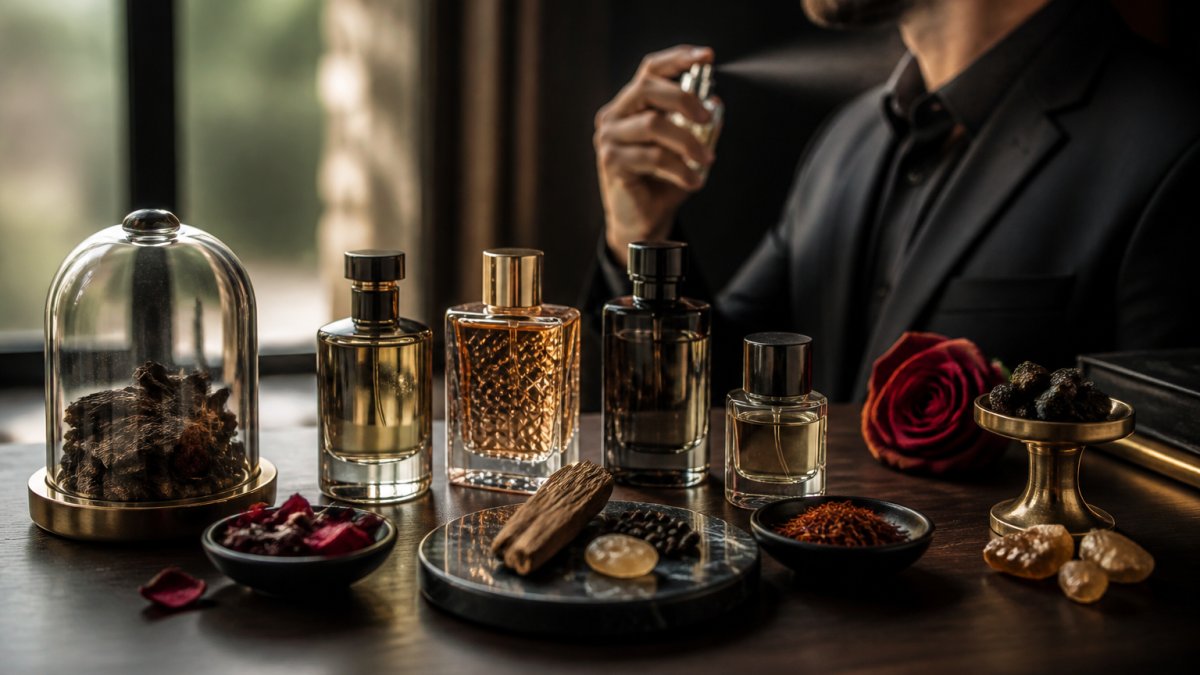
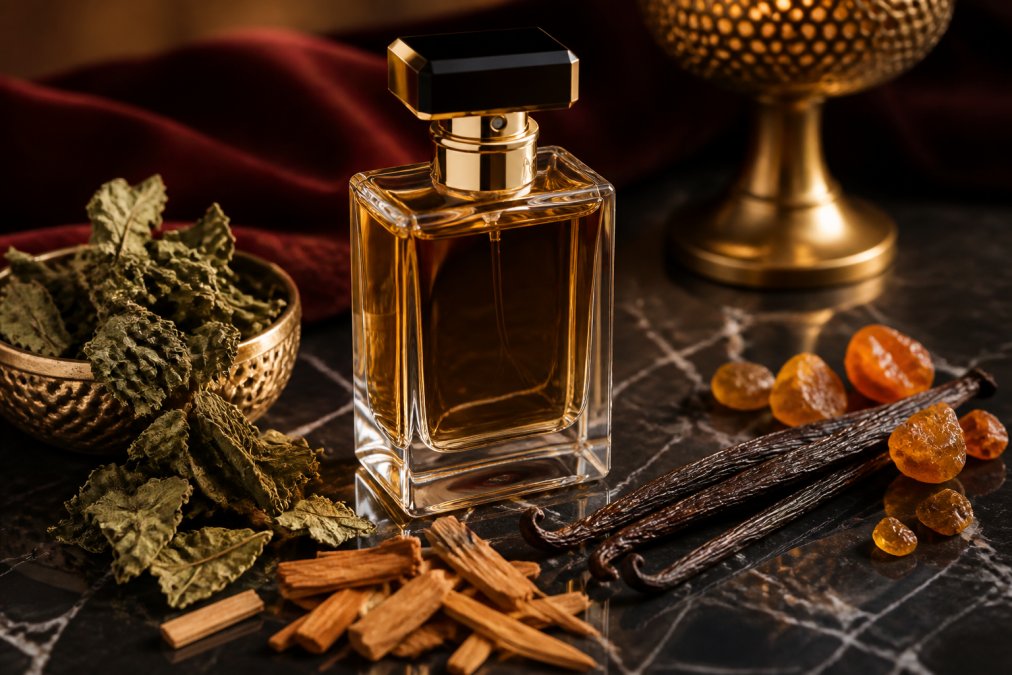
Base notes are the answer, and the heavier the better. Notes with fixative properties, they slow evaporation and anchor lighter materials, keep a scent detectable for eight hours or more. The table below ranks the main note families by typical staying power.
| Note Family | Examples | Typical Staying Power | Why It Lasts |
|---|---|---|---|
| Resins and ambers | Amber, oud, incense | Longest | Heavy molecules, low volatility |
| Woods | Sandalwood, cedar, vetiver | Long | Dense, slow-releasing compounds |
| Earthy and animalic | Patchouli, musk, leather | Long | Act as natural fixatives |
| Gourmand | Vanilla, tonka bean | Medium to long | Sticky, resinous texture |
| Florals | Rose, peony, jasmine | Medium | Varies widely by flower |
| Citrus and fresh | Bergamot, litchi, rhubarb | Shortest | Small, highly volatile molecules |
Woody Ambers, Resins, and Fixatives
Woody ambers and resins are the most reliable choice for longevity. Amber, oud, and incense are dense materials that release scent slowly over many hours.
Fragrance Families and Their Staying Power

Fragrance Concentration vs Longevity: EDP, EDT, and Extrait
Concentration is the second lever after note selection. The more fragrance oil a formula carries, the longer it tends to stay on skin.
- Eau de toilette (EDT): roughly 5 to 15 percent oil. Lighter, brighter, shorter wear.
- Eau de parfum (EDP): roughly 15 to 20 percent oil. The standard for all-day wear.
- Extrait de parfum: roughly 20 to 30 percent oil or higher. The densest and longest-wearing form.
How to Make Perfume Last Longer on Skin
Application technique decides how much of a formula's built-in longevity a wearer actually gets. Notes and concentration set the ceiling; application determines how close to it you land.
Prep the Skin First
Dry skin sheds fragrance faster than moisturized skin because there is less surface oil for scent molecules to bind to. A thin layer of unscented moisturizer or matching body lotion on pulse points gives them something to cling to; apply it first and let it absorb for a minute or two. This is the highest-leverage change most people can make, though results vary by skin type.
Shop Personalized Perfume Bottles →
Spray the Right Spots
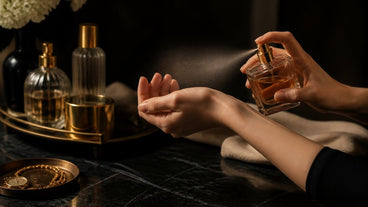
Pulse points work because body heat lifts the scent into the air. Classic targets are the wrists, inner elbows, base of the throat, behind the knees, behind the ears, and the nape of the neck. Heat also accelerates evaporation, so the goal is balance: enough warmth to project, not so much that the scent burns off by early afternoon.
Do Not Rub
Rubbing the wrists together after spraying is the most common mistake. Friction and body heat break down light top-note molecules faster than they would evaporate on their own, which can make an otherwise long-lasting scent seem to disappear within the hour. Spray and let it dry down undisturbed.
Distance and Damp Skin
Spray from roughly 15 to 20 centimeters away so the mist lands as an even film rather than a wet patch. Applying right after a shower, while skin is still slightly damp and warm, is a common trick because hydrated skin holds scent longer. A light mist through hair or onto clothing can extend the scent trail, though fabric and hair hold fragrance differently and should be tested first.
Layer Products, Not Just Perfume
A matching body oil or lotion under the fragrance adds a second layer of the same scent profile and gives the spray more to bind to, the simplest form of layering, since the products are designed to sit together.
Fragrance Layering Techniques for a Stronger Scent Trail
Layering builds a longer, more complex scent trail by stacking compatible fragrances and products, extending wear and creating something more personal than a single bottle.
- Apply a scented body lotion or oil first as a foundation.
- Spray a lighter, fresher fragrance as the top layer.
- Finish with a heavier base-note fragrance on pulse points.
- Keep families compatible: woody with amber, floral with musk, citrus with vanilla.
Storage, Olfactory Fatigue, and Skin Chemistry
Three factors quietly shorten how long a scent seems to last, and two are not about the perfume at all.
Storage and Degradation
Heat, light, and air break down fragrance molecules over time, and the base notes that provide longevity are often the most vulnerable: the heavy resins, woods, and ambers that anchor a composition oxidize and flatten first. A bottle on a sunny windowsill can smell duller within months, while one stored in a cool, dark cabinet with the cap sealed tight can hold its character for years.
Olfactory Fatigue
Olfactory fatigue, or nose blindness, is why wearers often think their perfume has faded when everyone around them can still smell it. The nose stops registering a scent it has been exposed to continuously, fastest with the notes you smell most often, a feature of human smell, not a flaw in the fragrance.
Skin Chemistry
Oily skin holds scent longer than dry skin because the surface oils that bind fragrance molecules are more abundant. Body heat, pH, and even diet shift how a fragrance develops, which is why the same bottle can wear differently on two people, and medications, hormonal changes, and seasonal dryness can change how it performs on the same person over time.
How to Choose a Long Lasting Perfume
Choosing well comes down to reading the base notes, checking the concentration, and testing on skin.
A focused checklist:
- Identify the base notes. Amber, oud, sandalwood, patchouli, musk, vanilla, and leather are the longevity leaders.
- Confirm the concentration. Eau de parfum or extrait will outlast an eau de toilette.
- Test on skin, not a paper strip, and wear it for a full day before deciding.
- Check the dry-down at hour six, since that is what most people around you will actually smell.
- Match the family to the occasion: heavier ambers and woods for evening, lighter florals and citruses for daytime.
Frequently Asked Questions
Which fragrance notes have the best longevity?
Base notes carry the longest wear because their molecules are heaviest and evaporate slowest. Look for oud, sandalwood, patchouli, musk, vanilla, amber, and resinous materials. Royal Elixir builds on oud, white amber, leather, musk, and Haitian vetiver, while La Royale Femme settles into cashmeran, cedar, and Haitian vetiver. A long lasting scent usually means a well-built base, not just a higher price.
How do base notes affect the lifespan of a perfume?
Base notes act as the anchor of the fragrance pyramid. Because they have low volatility and high molecular weight, they linger on skin for hours after the top and heart notes fade. Fixatives like musk, amber, and resins slow the evaporation of lighter molecules around them, which extends the overall scent trail. A fragrance with a thin or rushed base tends to disappear quickly, no matter how strong it smells at first spray.
Does skin type influence how long a fragrance lasts?
Yes. Dry skin releases fragrance faster because there is less oil to hold the molecules, while oilier skin tends to retain scent longer. Skin chemistry, body heat, and pH also shift how a scent develops. Applying an unscented moisturizer before spraying, and targeting pulse points like wrists, neck, and inner elbows, may help improve wear time on drier skin.
How can I make my perfume last longer throughout the day?
Start with moisturized skin, spray onto pulse points from about six inches away, and avoid rubbing your wrists together, which crushes the top notes. Spraying a light layer on clothing or hair can extend the scent trail. Carrying a travel atomizer for a midday refresh, and storing bottles away from heat and direct sunlight, also helps preserve performance over time.